
Bournemouth 1897 - The Whale on the Pier
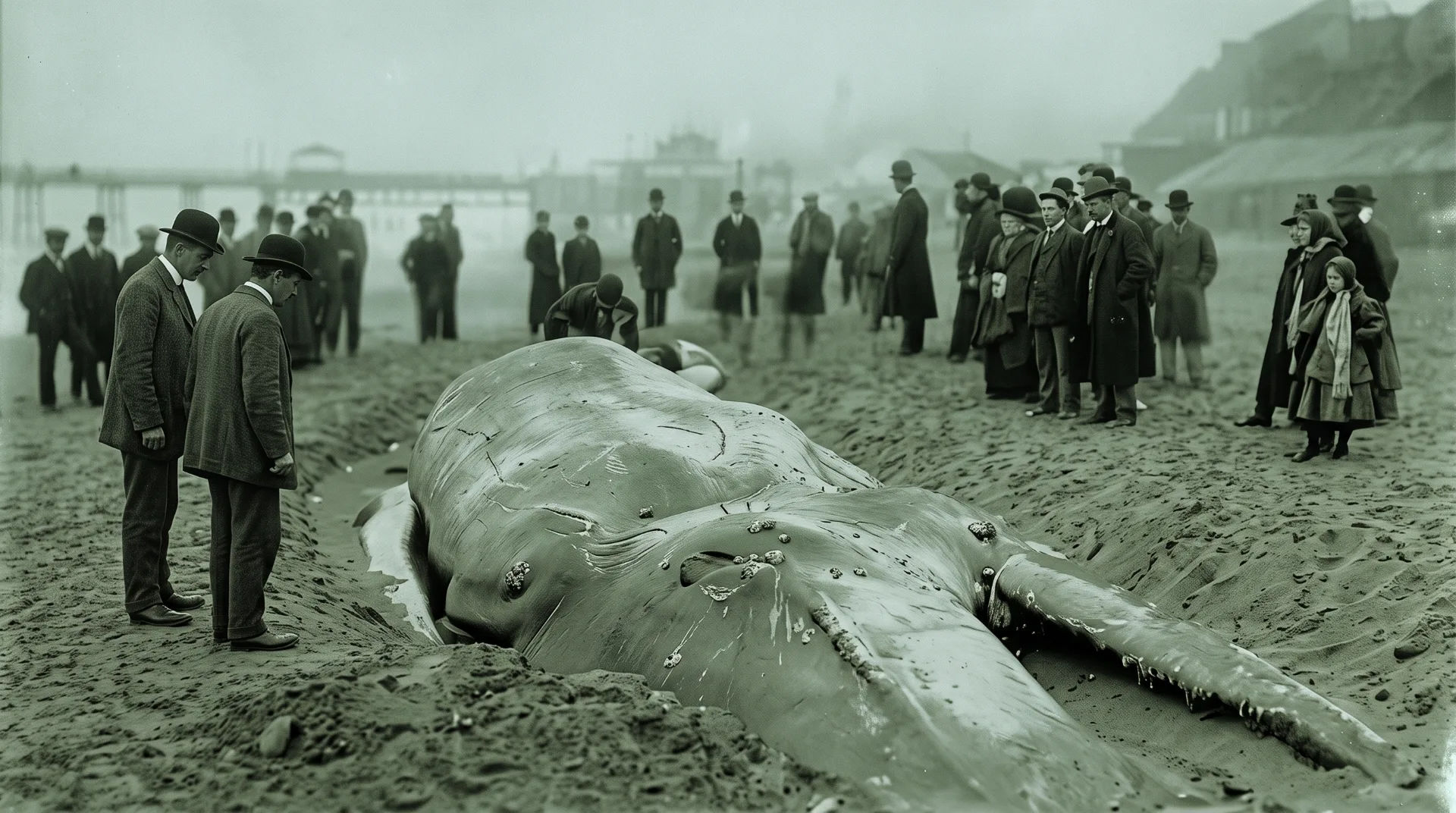
The Arrival of the Blue Whale: The 1897 Blue Whale Bournemouth Event
On the cold winter night of Tuesday 5 January 1897, a merchant ship passing near Bournemouth accidentally struck a blue whale just off the coast. Over the following days, the tides carried the enormous creature ashore on the beach east of Boscombe Pier. Measuring 70 feet in length and weighing over 40 tonnes, the whale quickly became a local sensation, attracting many curious onlookers. This extraordinary incident, known as the 1897 blue whale Bournemouth stranding, remains one of the most remarkable marine events in the town’s history.
The coastguard promptly arrived and claimed the whale as property of the Monarch. While officials debated what to do with this unexpected Crown acquisition, local schoolmasters took the opportunity to hold open-air lectures beside the whale. Children were often seen climbing its slippery sides and sliding down, turning the stranded giant into an impromptu playground.
Public Interest and Auction of the 1897 Blue Whale Bournemouth
The coastguard soon decided to auction the whale to rid himself of the responsibility. Despite persistent rain, the event drew crowds exceeding 500 people to Boscombe Beach, eager to witness the spectacle. Dr Spencer Simpson won the auction with a cheque made out to the Queen for £27, intending to display the whale’s skeleton for educational purposes.
However, Dr Simpson underestimated the scale of the project. The crowds kept growing, forcing him to hire a policeman to manage the visitors. The local Council grew concerned as the whale became a health hazard. Eventually, impatience led to the chief sanitary inspector, Mr Cooper, being sent to remove the carcass. This intervention sparked a confrontation during which Dr Simpson was arrested for assaulting the inspector with a sword stick.
Disposal and Auction of the Whale’s Blubber
The removal was ultimately successful. Most of the whale’s blubber was dumped off Brownsea Island, but some was transported to Poole Quay for auction at the King’s Arms pub. Despite wide promotion, only a few seafarers attended out of curiosity. Auctioneer Curtis energetically promoted the blubber’s value for manure and soap production, but Dr Simpson, who had spent £135 transporting it, received just five shillings in return.
This part of the 1897 blue whale Bournemouth story highlights the challenges faced in dealing with such a massive marine carcass in a seaside town. The blubber’s limited commercial success reflects the difficulties of turning natural history into profit at that time.
The Whale Skeleton on Boscombe Pier
The whale’s skeleton was eventually mounted on a frame and displayed on Boscombe Pier in 1897. Children delighted in climbing and sliding down the sun-bleached bones, much to the annoyance of the Assistant Pier Master. The skeleton remained a popular attraction for several seasons before being removed in 1904.
Displaying the skeleton on Boscombe Pier turned the 1897 blue whale Bournemouth event into a lasting public spectacle. It became a unique landmark, drawing visitors to the pier and adding to the town’s seaside attractions. The fate of the skeleton after removal is uncertain. Some believe parts were sold to private collectors, while much of it was reportedly stored at Powell’s marine store on Victoria Road in Springbourne.
Legacy of the Whale’s Jawbone
One definite relic is the 12-foot-long lower jawbone, which now resides on a farm near Blandford Forum. Local historian Andrew Emery has obtained a large segment of this jawbone, proudly displaying it in his office, much to the amusement of his colleagues.
The jawbone serves as a tangible connection to the 1897 blue whale Bournemouth event and the town’s maritime heritage. It reminds locals and visitors alike of the extraordinary encounter between Bournemouth and one of the ocean’s largest creatures.
Understanding the Significance of the 1897 Blue Whale Bournemouth Stranding
The stranding of such a colossal blue whale in 1897 was a rare and significant event for Bournemouth. At a time when marine biology was still developing as a science, this incident provided an unusual opportunity for public education and scientific observation. The whale’s size and the public’s fascination with it reflected the Victorian era’s curiosity about natural history and the sea.
This event also illustrates the challenges faced by coastal communities in dealing with stranded marine animals. Without modern equipment or knowledge, the disposal and display of the whale required considerable effort and led to unexpected social and legal conflicts.
The Blue Whale: Biology and Size
Blue whales are the largest animals ever known to have lived on Earth. Measuring up to 100 feet in length and weighing as much as 200 tonnes, they are truly giants of the ocean. The 1897 blue whale Bournemouth specimen was slightly smaller at 70 feet and over 40 tonnes, but still an impressive size that captured the imagination of the local population.
Blue whales feed primarily on tiny krill and are found in oceans worldwide. Their presence near Bournemouth’s coast was unusual but not unheard of, as these mammals occasionally venture into shallower waters.
The Impact on Bournemouth’s Coastal Culture
The 1897 blue whale Bournemouth event became a part of the town’s coastal identity. It drew attention to Boscombe Beach and Pier, which were already popular seaside destinations. The whale’s skeleton display added a unique attraction, contributing to the pier’s appeal and the town’s tourism.
This story is still remembered today as a fascinating chapter in Bournemouth’s maritime past, connecting residents and visitors to the natural world in a vivid way.
For more local stories and history, explore our blog and discover things to do in Bournemouth.
Related Attractions and Activities
- Visit Boscombe Pier to see where the whale skeleton was displayed.
- Enjoy a stroll along Bournemouth Beach, where the whale was first found.
- Learn about local wildlife at the Bournemouth Aviary.
Explore more about Bournemouth’s rich heritage, events and places to visit on our Things to Do and What's On pages. For accommodation options, see our Where to Stay section.